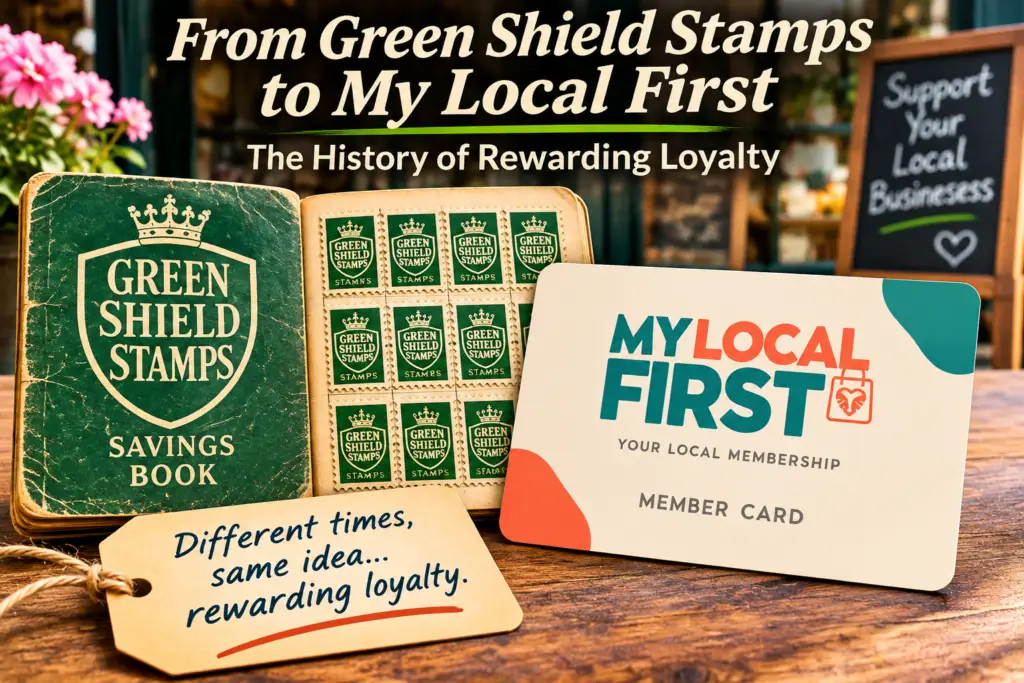
Remember collecting stamps in little books? The idea of rewarding customers is nothing new—but perhaps it’s time we remembered what loyalty was meant to be about.
One of my earliest memories of loyalty schemes
One of my earliest recollections of a loyalty scheme was Green Shield Stamps. Those little green stamps you collected when shopping, carefully stuck into books and saved until you had enough to exchange for something from a catalogue. There was something satisfying about watching the books fill up. Today we have apps, cards, points and member prices. But the idea of rewarding loyalty goes back much further—and originally meant something rather different.
The Co-op: when loyalty meant sharing in success
In 1844, 28 working people in Rochdale established the co-operative venture that helped shape the modern movement. They wanted good-quality food at fair prices, with members sharing in the business’s surplus according to their purchases. The famous ‘divi’ was not merely a marketing gimmick: members were owners, and the rewards reflected a principle of shared benefit. For generations, households remembered their Co-op numbers and looked forward to the dividend.
Green Shield Stamps: the little books that captured Britain
Richard Tompkins brought Green Shield Stamps to Britain in 1958, inspired by American trading-stamp schemes. Customers received stamps from participating retailers and petrol stations, filled savings books and exchanged them for household goods. Tesco became one of the scheme’s biggest partners. Kettles, toasters and other useful items gave families something tangible to save towards. Remarkably, Tompkins also launched Argos in 1973, building on the catalogue-and-showroom approach developed around stamp redemption.
Why did the stamps disappear?
In 1977 Tesco stopped issuing Green Shield Stamps and put its emphasis on lower prices. That decision helped accelerate the scheme’s decline. It raised a question that still matters: would people rather collect rewards or pay less in the first place? There is a cost to any loyalty programme, and businesses must make sure rewards are genuinely worthwhile without making their everyday prices uncompetitive.
From the divi to the Clubcard
Tesco launched Clubcard in 1995, and Nectar arrived in 2002. Stamps and books gave way to electronic points, personalised offers and increasingly sophisticated retail data. The Co-op changed too. In 2016 its membership scheme rewarded eligible Co-op purchases and supported local community causes; the percentages later changed, and in 2024 the organisation shifted towards member prices and offers rather than those percentage-based rewards. The original idea of sharing surplus has evolved into a different kind of customer benefit.
Have we lost something along the way?
Now it can feel as though every shop wants us to download another app or carry another card. Some retailers offer prices that are only available to members. If a product costs more because you have not joined, are you really being rewarded for loyalty—or charged more for not signing up? I think that is a fair question.
Why I created My Local First
The major retailers have had the budgets and technology for loyalty schemes for decades. Why shouldn’t the independent café, florist, butcher, salon or shop down the road have something similar? My Local First gives participating independent businesses a shared platform. Customers earn one point for every pound spent, and 100 points can mean £2.50 off their next purchase. Businesses can also offer their own rewards and promotions. But for me this is about more than points. It’s about where our money goes, who it supports and how we help keep our high streets alive.
More than a reward
Through The Grumpy Cook we’ve also seen how technology can help people access food support discreetly, without forms, judgement or embarrassment. I’d like My Local First to carry that same sense of community purpose. When we support an independent business, we support the people behind it, the local jobs it creates and the character it brings to our town.
Perhaps we’ve come full circle
The Rochdale pioneers believed ordinary people should share in the success of the businesses they supported. Green Shield Stamps gave families a visible reward for shopping. Modern loyalty cards made it digital. With My Local First, we’re trying to make loyalty work for independents and their communities. We no longer need to lick stamps and stick them into books—thank goodness! But the principle remains: reward loyalty, support businesses and give something back. Isn’t that what loyalty ought to mean?
Barry Ashley
Founder, The Grumpy Cook & My Local First
Do you remember Green Shield Stamps or collecting your Co-op divi? What did you save your stamps for? I’d love to hear your memories.